Tuesday, January 27, 2015

A day out with a naturalist


We spent much of the day in the Sous Massa National Park with a naturalist guide named Said who is an enthusiastic birder but also knows the flora and fauna well. We got all sorts of questions answered about plant species, and agricultural and Berber practices.

The park was established about 25 years ago in an effort to preserve wetlands for migrating birds, habitat protection for an endangered species (the Bald Isis), and control of desertification. We saw lots of egrets, herons, gulls, different kinds of ducks, sparrows, swallows, finches, owls, a juvenile flamingo, and many other birds. We didn't see the Bald Isis! Not being birders this was all very interesting but we didn't have a list that we were checking off.

The park straddles the Wadi Massa, a vast estuary with shifting sand bars. 


People are allowed to farm using traditional ways, but not allowed to build houses next to the cliffs (although we saw some "secret" houses) due to occasional flash floods and high water. This wadi last flooded in October and there are still plots of land under water as well as many ponds for the birds. People were harvesting reeds (used for baskets, furniture, ceilings, amongst other uses) and alfalfa for animal feed. We saw many protesting, overloaded donkeys, as well as overloaded baskets on the back of motorcycles or trucks.
Above the river are many villages--this mosque is particularly imposing.

We finished our walk along a wide and beautiful sandy beach that is usually filled with European tourists in the spring and fall. 

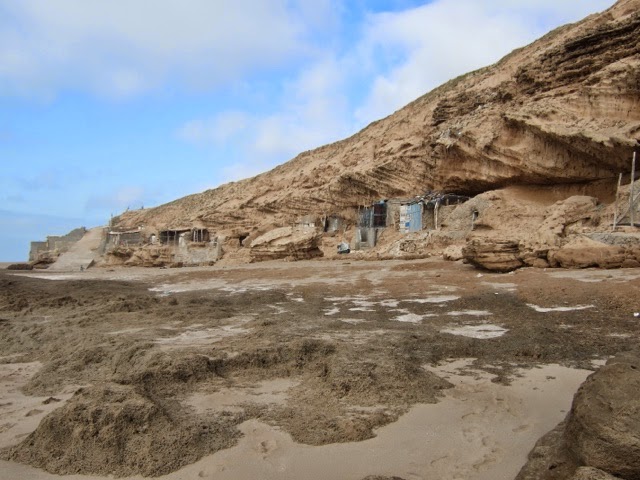
There were some curious structures built into the cliffs, and incorporating caves...they are fishermen's huts, and might have been in each family for years. 

We drove back to Taroudannt via some back country roads and went across yet another wadi showing the power of water when it comes down in a torrent as it did a few months ago.

Friday, January 16, 2015

Lucca


(Sitting on a crowded train to Firenze...and the man next to us keeps his bag on the seat next to him as people walk by looking for a seat... No one does anything--he doesn't acknowledge the walkers and they don't ask him to move it to the floor. These little cultural differences are interesting to travellers! Meanwhile we're about to do something remarkable in that we're going to Florence (Firenze) for only a day! The 2 guidebooks we have consulted offer itineraries for 3, 5 and 7 days, not for one! Seems criminal, in fact we contemplated not going at all, however it's only an hour away by fast train. So we have decided to focus on Michelangelo. We have tickets to see "David" at noon, and will visit nearby sights before and after.)

Yesterday we took the regional train to Lucca, an ancient city whose 16th C fortifications are still intact, forming a lovely green ring around densely packed buildings. We entered the city walls about 200 m from the station 

and turned right, walking along the top of the walk counterclockwise. 

At the 12 o'clock position we came down off the wall and found the Piazza dell Anfiteatro Romano, a plaza completed circled by buildings, built on the original 2nd C Roman amphitheater. 
At one of the entrances:

Outside:

We wandered almost aimlessly in narrow lanes, enjoying the lack of cars (the only vehicles allowed inside the walls are for residents and deliveries). Most streets are for pedestrians and cyclists only, and there were many people on single speed bicycles with baskets on front for their shopping.

Another thing we enjoyed about Lucca...no touts! No one trying to sell us hats, iPhone cases, scarves, guidebooks, postcards, selfie sticks, umbrellas...

See that tower in the distance with the green on top? 

That's the Terre Guinigi, a medieval tower which has trees growing on top. The guidebook said that the tree roots are visible in the room below but that's not true. That ceiling is very much intact. We climbed up to the top for the view...

Lloyd in a pensive moment:

Here's the Duomo or cathedral in Lucca...such eclectic designs on the front...carved and smooth pillars, some decorated with checkerboards, swirls, and other designs made with marble inlays. Expand this image for a closer look. It looks as though the masons building the tower were conserving their marble blocks...

Lucca is Puccini's birthplace and he is much celebrated here. There are concerts most weekends and a big festival in the summer. This statue of him is in front of his birth home (now a museum but closed when we were there): 

The square was surrounded with cafes, restaurants and bars with names like Bohemian cafe, Bar Tosca, Madama Butterfly Ristorante, etc. Lloyd had just asked me what Puccini had written, and I said I think the answer is all around us! 
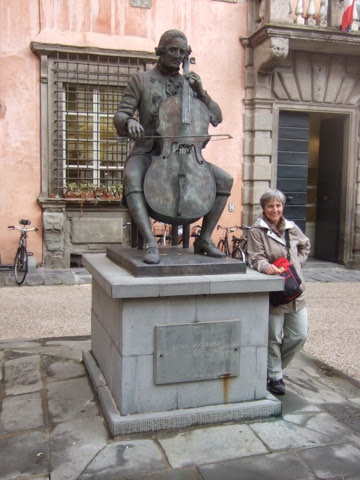
This statue of a cellist was in front of a music school:

We returned to Pisa by train, only 20 minutes away, but not very comfortable for Lloyd. He rarely finds seats in trains, buses, and planes big enough!

We arrived back at the hotel in time for a little knitting in the comfy chairs in the lobby, and then supper at a Pakastani kabab cafe around the corner. They also had a variety of hot food, and I enjoyed a very yummy chickpea and egg curry with rice pilau. It was actually a very welcome change from Mediterranean fare. (Lloyd had the meat kabab with chips...) 

Wednesday, January 14, 2015

Pisa

 The tower of Pisa still leans!

Some of the hawkers at the entrance tried to sell us "selfie sticks" and enjoying each other's company too. Those umbrellas were popular sellers about an hour later in a downpour.

The tower leans at a 5 degree angle. Here's an interior shot.


There over 250 stairs up, and limited to about 30 people every half hour.

Some views from the top...

And from another angle...see the slight banana curve from 20th C repair and stabilization work.

We had a wander through the cathedral near by, and I was struck by this painting...the angel seems to be taking a selfie!  Believe me, we are seeing SO many tourists taking selfies.

We had a fabulous lunch at a "hole in the wall" in a narrow lane nearby. There isn't a lot of seating--most of her business is "take away". Lloyd had roast pork with roasted veggies and potatoes, while I had spinach lasagna...3 small sheets of fresh noodle interspersed with spinach, mozzarella and sliced tomatoes. Simple and yummy.

The rain had tapered off by the time we reached the river...

After lunch we went to a special exhibition of "Modigliani et ses Amis". He's the early 20th C painter and sculptor known for his long faces. Included in the exhibit were works by Picasso, Chagall and others. www.modiglianipisa.it

Followed by a lazy afternoon knitting (me) and snoozing/reading (Lloyd). Then another nice dinner at the same trattoria "Il Viale" as we went to last night. It was nice to be greeted warmly with recognition!

Tuesday, January 13, 2015

Last observations about Malta

Random thoughts about Malta as we departed...
1. Evidence of Malta as a former British colony: Red mail boxes inserted into walls, or freestanding red pillars, with the initials "GR" (from the days of King George VI), red telephone boxes with "Soane's domes", huge and cheap bars of chocolate, good tea, chips with almost everything in almost every restaurant, English spoken widely albeit with a definite Maltese accent, right-hand drive vehicles, pubs with names like "The Salisbury Arms", hotels with names like "The Empire", and houses with nameplates like "Canada", "Kangaroo", and "The Oak"; cakes like bananatoffey, chocolate orange, and double chocolate (all of these we enjoyed with a welcome cup of tea after a good walk)

2. Crowded! Malta is the most densely populated member of the EU. And the corollary is that there isn't a lot of countryside. Walks in "rural" Malta were mainly on secondary roads and tracks.

3. The Maltese are friendly and cheerful and respond to our smiles and greetings, however on buses they're oblivious to other passengers, rarely giving up seats to people with greater needs or making room for baby strollers.

4. For 5000+ years the people of these islands have been tunnelling through the soft limestone and building structures underground (e.g. The Hypogeum). There is a network of tunnels underneath the city of Valletta started by the Knights of St. John in the 16th C. These tunnels were increased in the 20th C and used during wartime, including the Cold War. Until the mid 20th C and the advent of municipal water pipes, every house had to have at least one cistern to collect rain water. In fact it was during the construction of a cistern that the Hypogeum was discovered in the early 1900s. The Casa Rocca Piccolla that we visited yesterday used to have 3 cisterns...one was constructed 300+ years ago to collect drain water from the street to water the orange trees in the garden (considered a great luxury). This large cistern was drained and used as an air raid shelter for the neighbourhood in WW II. Over 100 people could fit in this space.

5. "Marsa" is a Maltese word meaning "harbour" and is a prefix for many town names (e.g. Marsaxlokk and Marsaskala). It is derived from the Phoenician and can be found in other countries as well, e.g. Marsala in Sicily and Marseille in France. The Maltese language, Malti, is an officially recognized language at the UN and EU even though it is only spoken in Malta, a population of about 400,000 (25,000 of these live on Gozo). There are at least 400,000 people around the world (Australia, Canada, USA, UK) claiming Maltese descent. Malti is a Semitic language, mainly Arabic with some Italian and English) and the script is similar to English with another 6 symbols for sounds unique to Malti. We heard Malti all around us with people switching with great ease into English. 

6. Most doors had interesting doorknobs and knockers like these dolphins:

We found out during our tour of the co-cathedral of St. John that the dolphin was the symbol of the "Langue of Auvergne" one of the sections of the Knights of St John, former rulers of Malta.

7. Maltese cuisine: rabbit stewed or fried, fresh fish and seafood, fabulous bread (Ftira in particular--a round of crusty flatbread used for sandwiches--a sourdough made with high gluten flour), delicious Maltese wine especially the white wine made from the indigenous grape "girgentina", tasty and crunchy strawberries, sweet oranges and clementines, tender lettuce.

8. It may be nice and warm during the day, about 16 degrees C, but the houses are cold at night! A hot water bottle wrapped in my nightie was sure welcome! A few times I even went to bed wearing tights and socks as well.

For our last day in Malta, we opted to take a harbour cruise. Here are some photos from the water of the old fortifications (restored or in process--Valletta is getting ready to be the European City of Culture in 2018) 


and shipbuilding industry--an oil tanker was coming in as we were going out, 

and at a neighbouring berth, a Greenpeace vessel...

Followed up by a walk around the point...

And then a lazy lunch on the other side of Sliema at the cafe L'Aroma where we enjoyed another tasty sandwich of Ftira bread.

We then took the X2 bus to the airport...our last look at Maltese architecture and cityscape...  


We're now in Pisa for 4 days enroute to Morocco. Have to brush off my Italian again! Had a little fun in a trattoria tonight ordering food...the waiter was very patient and graciously corrected and confirmed our order.  He was so nice and patient we just might go back! And the food was good too--we just had bruschetta, salads, and local Tuscan wine. We're staying at Hotel Alessandro Della Spina, a former elegant mansion near the station. It has heating! And a heated towel rack!! What luxury!


Saturday, January 3, 2015

Taormina, and leaving Sicily


...Written between 9 and 10 AM Saturday, but posted much later from Malta. 

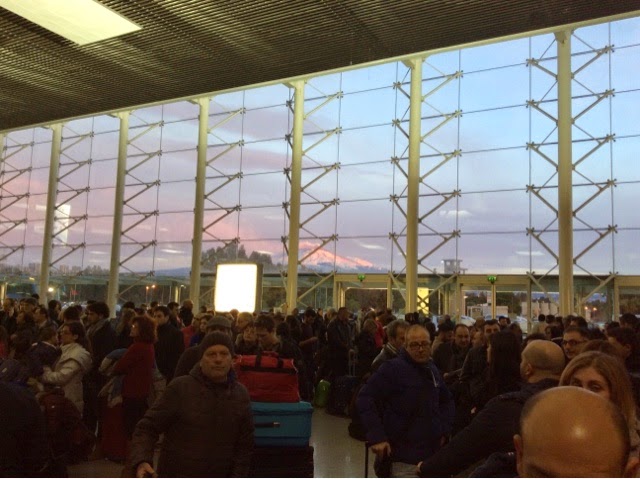
I'm writing this from the departure lounge of Catania airport at 8:30 AM where we're waiting to see when our Air Malta flight will leave...our 7:45 AM departure appears to have been delayed at least 3 hours due to volcanic ash! The same plume of ash that we noticed on the south face of Mt Etna yesterday is still billowing forth intermittently. Here are some photos of yesterday's events followed by a couple of pictures taken at 7 AM today from inside the terminal:


And of course there's no information...just a notice on the departures board saying that flights may be delayed due to ash. A plane has just landed so that's a good sign. ( 9 AM...a plane has taken off! Another good sign but our plane isn't even here yet...9:40 AM it just arrived...10:15 we're boarding!)

Yesterday we took the bus north to Taormina, another city founded by the Greeks and taken over by the Romans, then ruled by Byzantium before falling to the Saracens...all this taking place well over 1000 years ago. It's a hilltop town that was discovered by rich young men on their Grand Tours in the 18th and 19th centuries and then the artists and writers found it in the late 19th and early 20th C, Oscar Wilde among them. It is still taken over by Hollywood notables every year for a film festival and there are a few other music and opera festivals, all taking place in the ancient Teatro Greco, Taormina's main attraction. Here's the poster advertising the opera festival this summer. Wouldn't this be fun! (Lloyd says start buying lottery tickets so we can return and stay in style at one of the ritzy hotels dotting the hillsides...)

Most of what we see of the Teatro now is what the Romans added...the walls and arches.  They also used chunks of the Greek pillars and capitals within these walls.


The Teatro is actually most impressive viewed from a distance. We went for a short hike up a nearby peak (20 minutes of stairs) and could clearly see that the Teatro is nestled neatly in a bowl.


Houses, apartment blocks and luxury hotels appear to tumble down the hillside from this vantage point. 

And also from another nearby peak...


Picnic lunch at the top:


Inside the church at the top:

Back down In the town, we came across the partially excavated ruins of a Roman amphitheater:

Lloyd squeezed into the narrowest street in Taormina:

We have had an excellent experience in Sicily. There is much to be recommended...ancient history, fabulous Greek, Roman, Saracen and Norman ruins...spectacular mosaics at the Villa Romana...but above all the warmth, friendliness and curiosity of the Sicilianos. There are many encounters never to be forgotten...trying to communicate in broken French with our hosts, ordering food, buying bread, Lloyd getting his beard trimmed, wanting only one lettuce but being convinced by the vendor to take two for the price of one at the end of the day, and so on. Navigating in cities! Whew! Being faced with a fabulous selection of wine in even the smallest of shops: from really cheap (between 2 and 3 euros) plonk in 2 litre plastic bottles (just like soda pop) to 1 litre tetra paks of "vino locale" to much more expensive (7 euros and up) for the wine produced in designated areas such as we experienced at the Mt Etna winery. And last night we had our cheapest wine yet--Lloyd took an empty bottle to the wine shop around the corner and had it filled from the barrel (2 euros). It wasn't bad--just didn't have the body and full flavour of some others. What we won't miss is looking for fresh milk (rather than UHT) and strong tea! Italians just don't drink tea like we do. We found a box of Twinings super intense tea in a supermarket in Marsala, and then had to eke it out over the next 2 weeks because we never found it again. 

Lloyd would also like it to be known that he is now back to wearing shorts! The temperature has risen to about 12 degrees or so. Here he is at the lookout at the Villa Communale, a public park nicely maintained, on the edge of Taormina.

We're now settling into Asti Guest House in Valletta, Malta and have just had a fabulous cup of tea! Malta has definitely got an English flavour...the signposts are all in English, cars are on the other side (right hand drive), and billboards on the highway coming in from the airport were advertising British goods. We're off now to find lunch, and get oriented to this city, one of the first "planned" European cities to be built on a grid system.